> For the complete documentation index, see [llms.txt](https://docs.realmacsoftware.com/elements-docs/llms.txt). Markdown versions of documentation pages are available by appending `.md` to page URLs; this page is available as [Markdown](https://docs.realmacsoftware.com/elements-docs/hosting/elements-hosting-reactor-panel/websites/manage-websites/ftp-accounts/how-to-publish-your-elements-site-using-ftp.md).
# How to publish your Elements site using FTP
Fast, no-hassle publishing from the Elements app to your Elements Hosting account.
Publishing from the Elements App to your Elements Hosting account has been designed to be fast and easy.
Below are the steps to publish your Elements sites using FTP.
#### Step 1
Log into the [Elements Hosting Reactor Panel](https://reactor.elementshosting.io/login) and navigate to the FTP user you'd like to use for publishing/uploading your site via the Elements App.
Take note of the following:
* FTP Username
* FTP Password
* FTP Host
* Directory Access - Pay attention if your FTP user has access to the root folder `(/)`, or if they only have access to a specific website's home folder, such as `/public_html`. In the below screenshot, our FTP user has access to the root folder, meaning they have access to all sites hosted under that account.
#### Step 2
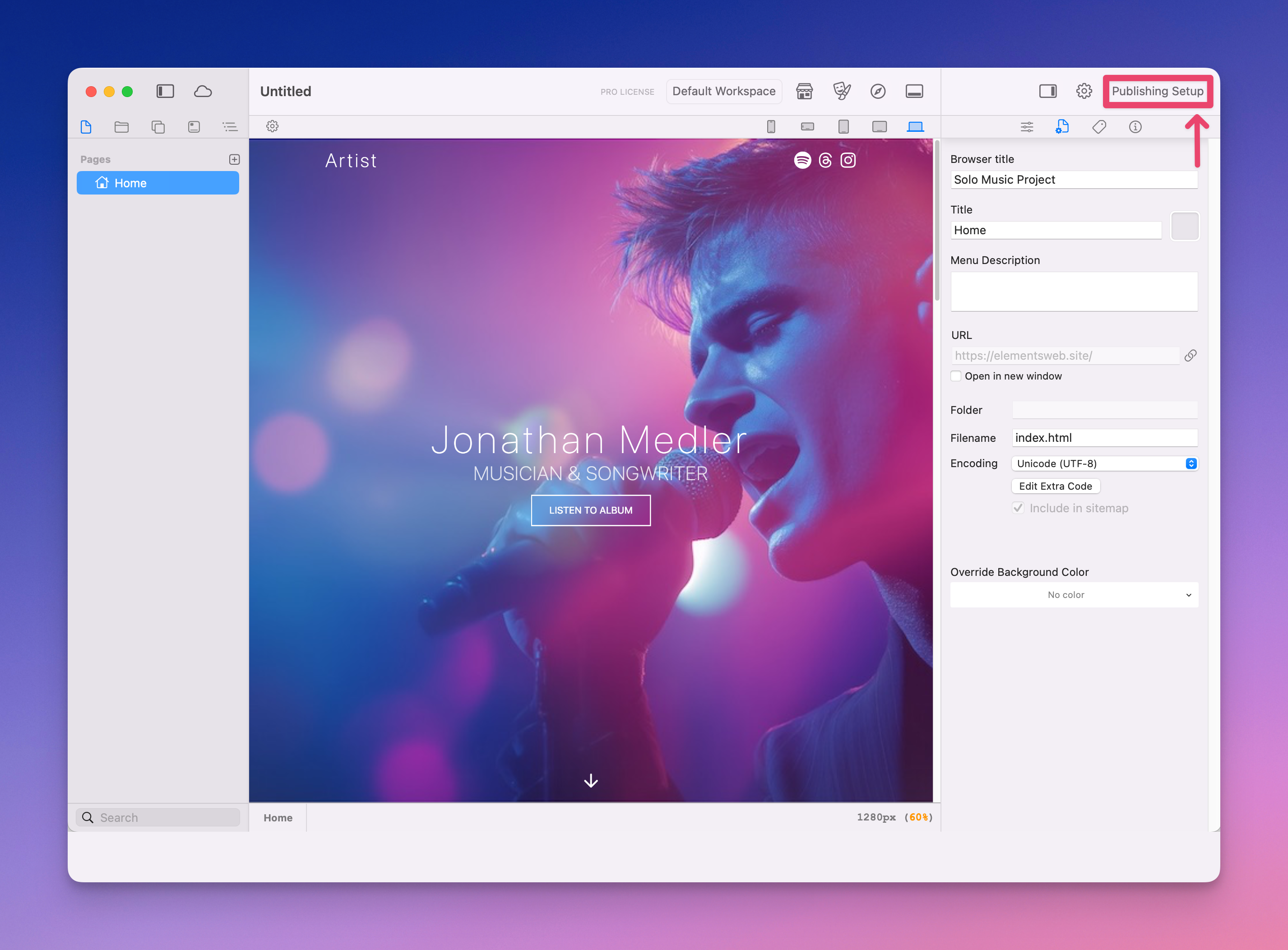
In the Elements App, click on `Publishing Setup` in the upper right-hand corner of the app window.
#### Step 3
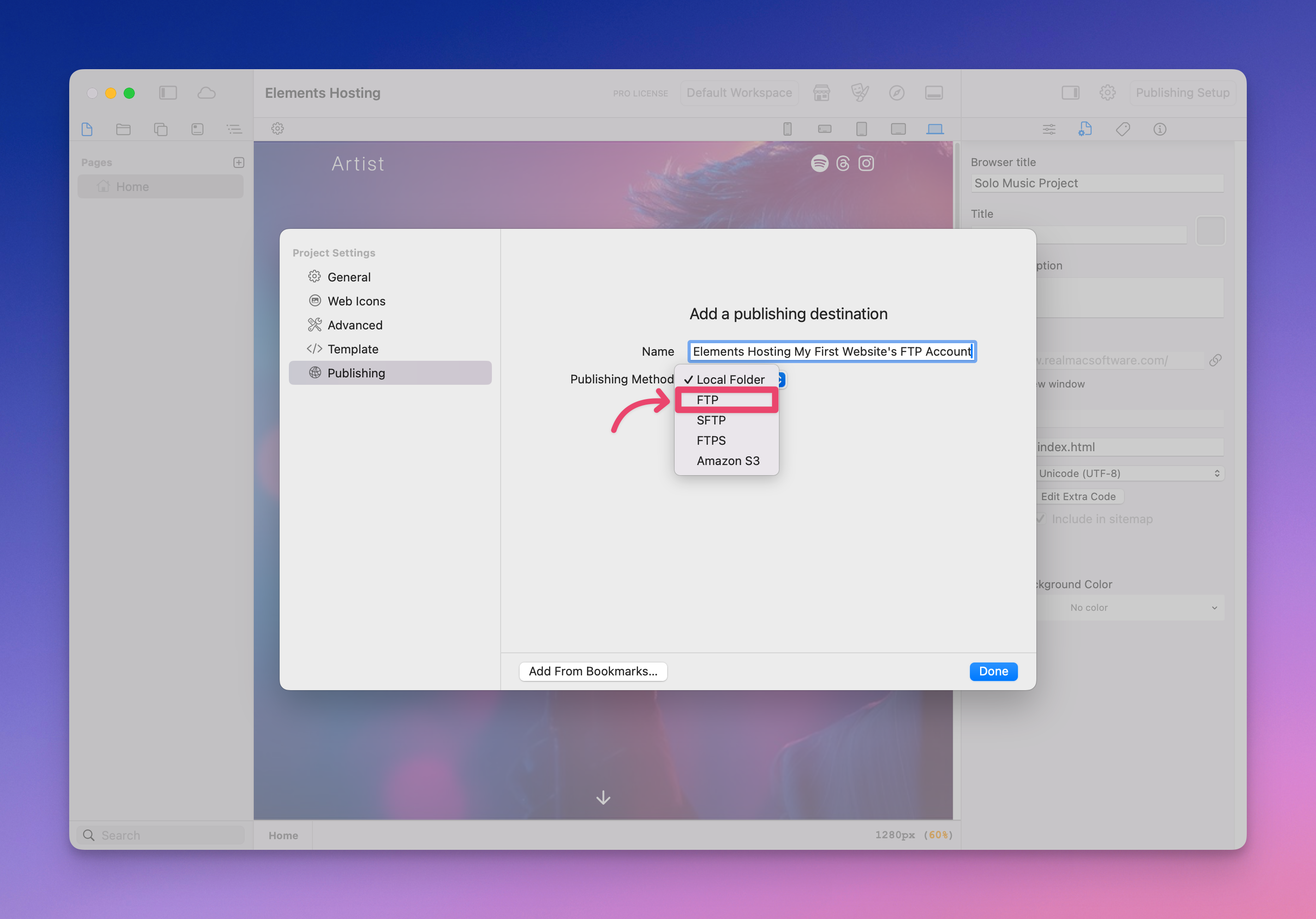
Give your publishing destination a name in the `Name` field, and select `FTP` from the `Publishing Method` drop-down menu.
#### Step 4
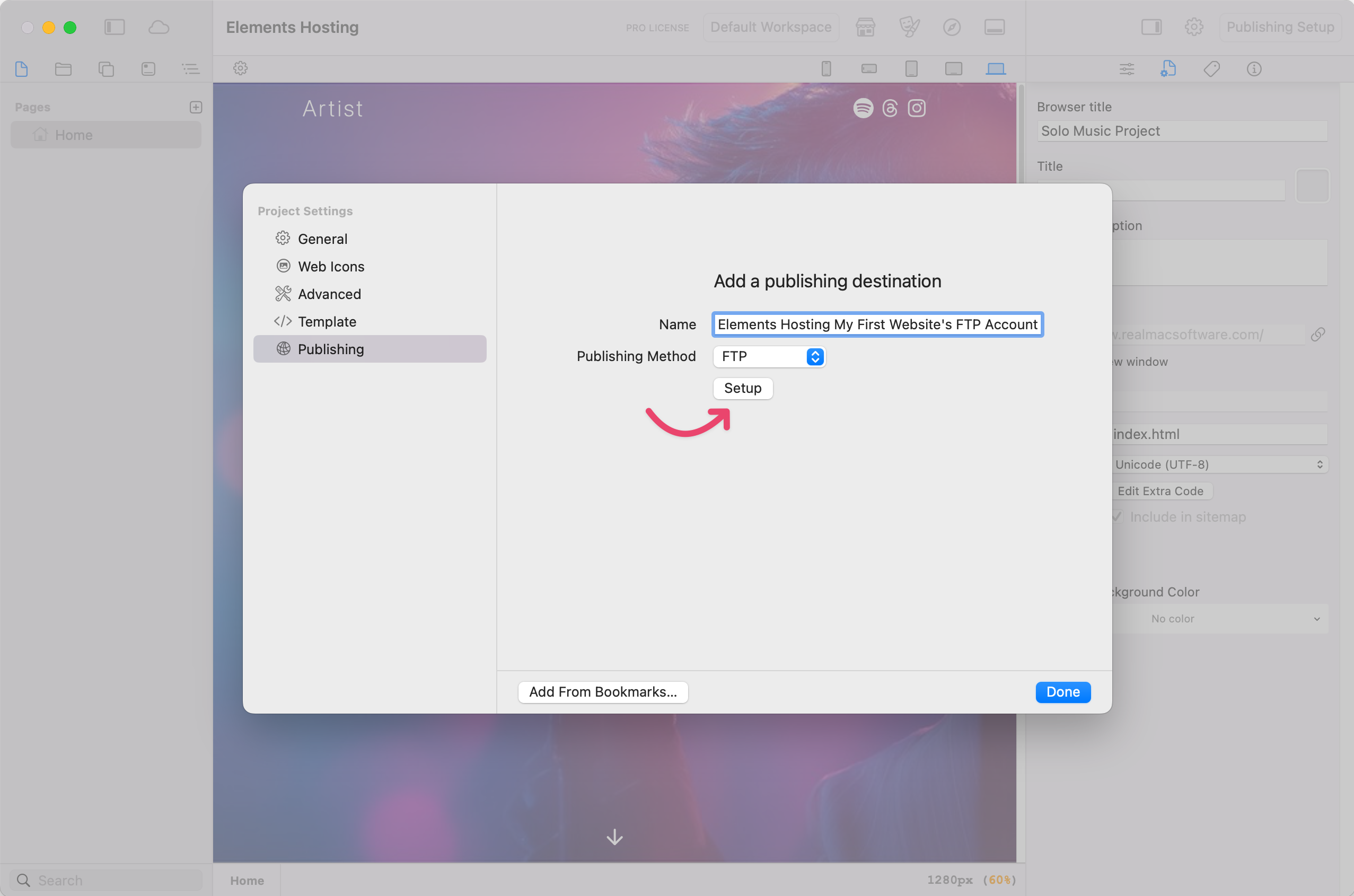
Click the `Setup` button.
#### Step 5
Enter your FTP user details from [Step 1 above](#step-1).
1. **Publishing Method:** FTP
2. **Server:** Your Host/Server IP Address
3. **Connections:** 1 (very slow) to 6 (very fast)
4. **Username:** Your FTP Username
5. **Password:** Your FTP Password
Click the `Test` button in the lower-left of the window to confirm you've entered your FTP connection details correctly. You will see a pop-up window telling you if the connection test was successful, or if it failed. If it fails, please double-check your FTP connection details, that they are entered correctly, and test again.
#### Step 6
Next, in the `Path` field, select the folder where your website will be uploaded to by clicking the `Browse` button, selecting that upload folder, clicking the `Choose` button, then clicking the `Done` button.
Generally public\_html will be what's entered in the `Path` field if you are only hosting one website with us. If you are hosting multiple websites on your Elements Hosting account, you will need to make sure you select the correct folder to upload to. When in doubt, ask us. 🙂
{% hint style="info" %}
From [Step 1 above](#step-1), if your FTP User's **Directory Access** is already listed as the website's upload folder (e.g. `public_html`), then you don't have to enter anything in the `Path` field in Elements Publishing Settings (leave it blank).
{% endhint %}
#### Step 7
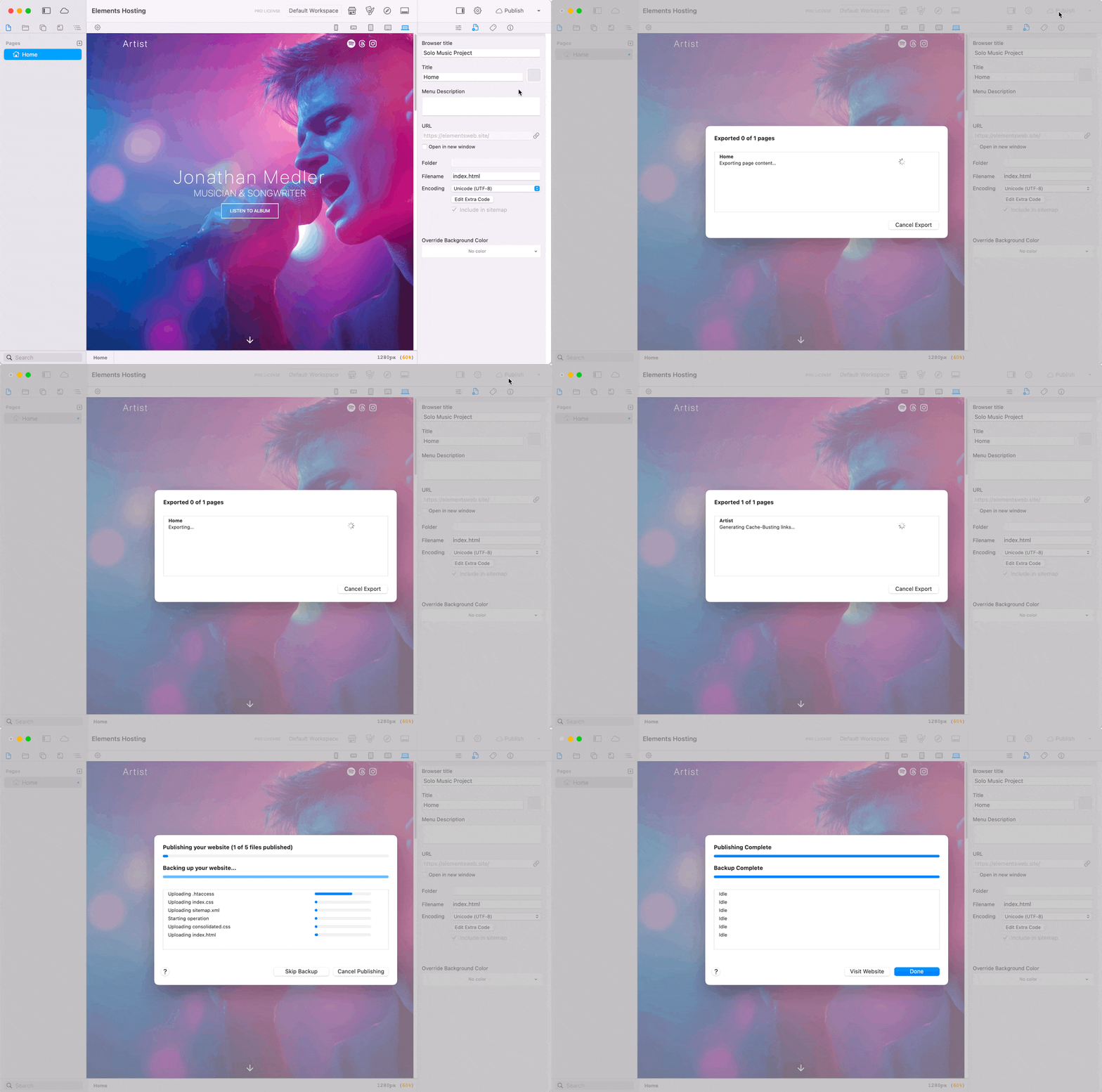
When you are ready, click `Publish` in the upper right-hand corner of the window, and watch as your website gets published to your Elements Hosting account! 🎉
{% hint style="success" %}
You can now open up your web browser and witness the Power of Elements™️, no magic-wand required! 🧙
{% endhint %}
---
# Agent Instructions
This documentation is published with GitBook. GitBook is the documentation platform designed so that both humans and AI agents can read, navigate, and reason over technical content effectively. Learn more at gitbook.com.
## Querying This Documentation
If you need additional information that is not directly available in this page, you can query the documentation by asking a question.
Perform an HTTP GET request on the following URL with the `ask` and `goal` query parameters:
```
GET https://docs.realmacsoftware.com/elements-docs/hosting/elements-hosting-reactor-panel/websites/manage-websites/ftp-accounts/how-to-publish-your-elements-site-using-ftp.md?ask=&goal=
```
`ask` is the immediate question: it should be specific, self-contained, and written in natural language.
`goal` is what the user is ultimately trying to achieve, the reason they need the answer. Sharing it helps GitBook give you a better, more relevant answer. A goal is most helpful when it describes the outcome the user wants rather than restating the question. For example, with `ask=how do I create an API token`, a goal like `automate deployments from our CI pipeline` lets GitBook tailor the answer to that use case.
The response will contain a direct answer to the question and relevant excerpts and sources from the documentation.
Use this mechanism when the answer is not explicitly present in the current page, you need clarification or additional context, or you want to retrieve related documentation sections.